
Bill split calculator
for any table, any tip.
Enter the bill's subtotal, tax and tip, then either the number of people for an even split or each person's items for an itemized one, and the calculator shows what everyone owes. Below it you'll find how to use it step by step, the formula it uses, general tipping ranges, and the mistakes that make a split come out wrong.


Bill split calculator
Example filled in: dinner for four with a shared appetizer. Tax and tip are split in proportion to what each person ordered.
| Name | Their items ($) |
|---|
How to use the bill split calculator
- Enter the subtotal. This is the food and drink before tax and tip. It's usually printed just above the tax line on the receipt.
- Enter the tax. Type the dollar amount from the receipt. If you only know the rate, multiply the subtotal by it (8% of $90 is $7.20).
- Choose a tip. Pick a percentage, or type a dollar amount if you've already decided. If the bill already includes a service charge, enter zero here.
- Choose even or itemized. For an even split, enter the number of people. For an itemized split, add each person and the total of what they ordered, including their share of anything shared.
- Read the result. Each person's amount includes their share of tax and tip.
Before you send anyone a number, check that the item totals you entered add up to the subtotal on the receipt. If they don't, it's almost always a forgotten item or a shared dish someone left out.
The math behind it
An even split is one line:
- Each person = (subtotal + tax + tip) ÷ number of people
An itemized split uses a multiplier so tax and tip are shared in proportion to what each person ordered:
- Multiplier = (subtotal + tax + tip) ÷ subtotal
- Each person = their items × multiplier
Here's a worked example. Three friends, Sam, Alex and Jo, have dinner. The subtotal is $90, tax is 7% ($6.30), and they tip 18% on the subtotal ($16.20). The total is $112.50.
Even split: $112.50 ÷ 3 = $37.50 each.
Itemized split: Sam's items came to $40, Alex's to $30, Jo's to $20. The multiplier is $112.50 ÷ $90 = 1.25.
- Sam: $40 × 1.25 = $50.00
- Alex: $30 × 1.25 = $37.50
- Jo: $20 × 1.25 = $25.00
Those add to $112.50. Notice that Alex pays the same either way because his order was exactly average. Jo saves $12.50 by itemizing, and Sam pays $12.50 more. That's the trade-off in a nutshell: the further an order is from the average, the more an even split moves money from one person to another.
For a longer walkthrough with shared appetizers and a drink-only guest, see how to split a bill with tax and tip.
How much to tip: general ranges
Tipping norms vary a lot by country and by type of place, so treat these as general guidance, not rules.
In the United States, a few common ranges:
- Sit-down restaurant: 15% to 20% of the pre-tax bill is the usual range, with 18% to 20% common for good service.
- Bar: a dollar or two per drink, or 15% to 20% of a tab.
- Counter service or coffee: optional. Many people leave a small amount or round up.
- Delivery: often 15% to 20%, with a few dollars minimum on small orders.
- Large groups: check for an automatic service charge before adding anything.
Outside the US, it's often quite different. In many countries a service charge is included in the price or added to the bill, and tipping on top is either small or not expected at all. If you're traveling, look up local custom before you go, and always check the receipt for a service line.
Whatever your table decides, apply the same tip percentage to everyone. The calculator does that for you.
Couples, shared plates and people who leave early
Real tables are messier than “four people, four meals.” A few ways to enter the common cases:
- Couples paying together. Enter them as one person with their combined items. In the example above, if Alex and Jo were a couple, they'd enter $50 together and owe $62.50 as a unit.
- Shared plates. Divide each shared dish among the people who ate it and add that to their item totals before calculating. A $24 appetizer for three people is $8 on each person's line.
- Someone who leaves early. Have them pay for their items times the multiplier before they go. If you don't know the final tax and tip yet, use the tax rate on the menu and your planned tip, which will be close.
- One person treating another. Move the guest's items onto the host's line. The math stays the same.
- A bottle of wine for some of the table. Treat it like a shared plate, split among the people drinking.
Whichever way you enter it, the check is the same: the lines should add up to the subtotal, and the results should add up to the total.
Common mistakes when splitting the check
- Tipping twice. Many restaurants add an automatic gratuity for larger parties. If you see a service charge on the bill, it usually replaces the tip.
- Forgetting tax in an itemized split. Paying for your $20 entree with a $20 bill leaves the payer covering your tax and tip.
- Rounding everyone down. If four people each round down 40 cents, the person who paid is out $1.60. Round up, and let the extra go toward the tip.
- Splitting evenly when one order was tiny. A friend who had one drink shouldn't pay a quarter of a full dinner. Itemize, or take their drink out and split the rest.
- Leaving shared dishes out. If a $24 appetizer isn't assigned to anyone, the item totals won't add up to the subtotal and the payer absorbs it.
- Forgetting the payer's own share. The person who put it on their card owes their portion too. They should be paid back the total minus their own share, not the full bill.
- Mixing tip bases. If one person calculates 20% on the total and another on the subtotal, the shares won't add up. Pick one base for the table.
A quick template for the group chat
Once you have the numbers, send them in one message so nobody has to ask. Copy and fill in:
“Dinner came to $112.50 with tax and 18% tip. Itemized:
- Sam $50.00
- Alex $37.50
- Jo $25.00
I paid, so Alex and Jo, send yours when you get a chance.”
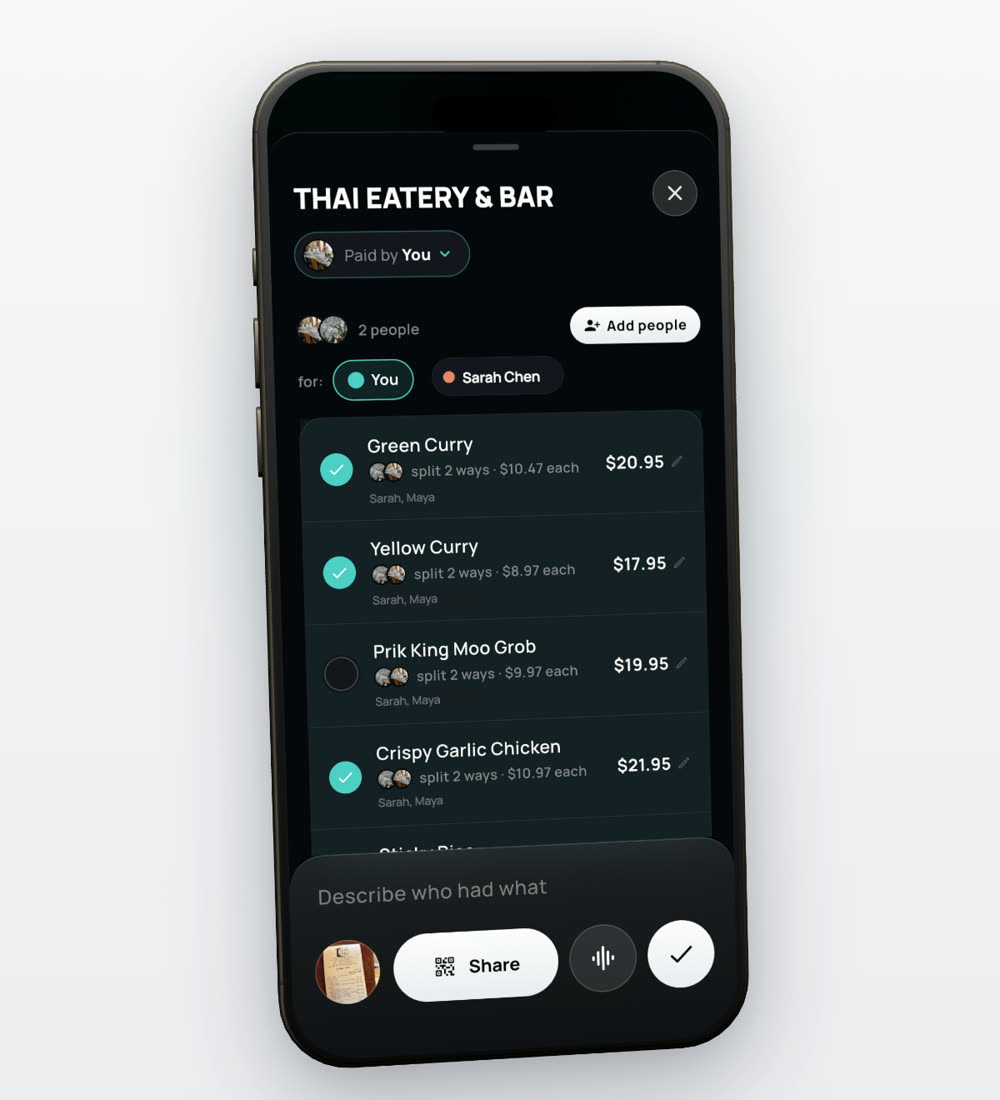
If you split with the same friends often, logging dinners in a shared group means the amounts add up in one running balance and you can settle once a month instead of after every meal. In Chipp you can scan the receipt, assign items, and everyone can settle through Venmo, Cash App, Zelle, PayPal, bank, or Chipp Balance. For the follow-up when someone forgets, these polite reminder messages help.
Questions people ask
How do you split a bill evenly with tip?
Add the subtotal, tax and tip together, then divide by the number of people. For a $90 subtotal with $6.30 tax and an 18% tip of $16.20, the total is $112.50, so three people pay $37.50 each. If you're rounding, round each share up rather than down so the person who paid isn't left short.
How do you split a bill when people ordered different amounts?
Use an itemized split. Add up what each person ordered, divide the full total by the subtotal to get a multiplier, and multiply each person's items by it. With a $112.50 total on a $90 subtotal, the multiplier is 1.25, so someone who ordered $20 of food owes $25 including their share of tax and tip.
Is 18% or 20% the standard tip?
In the US, 15% to 20% at sit-down restaurants is the usual range, and many people treat 18% to 20% as standard for good service. Norms vary by region, by type of place, and especially by country, where service is often included. Whatever you choose, apply the same percentage to everyone when splitting so the shares stay fair.
Should the person who paid the bill pay less?
No. They owe their own share like everyone else, so they should be paid back the total minus their portion. Some groups let the payer keep any card rewards as a thank-you for fronting the money and collecting it, but adding a fee or rounding everyone up to profit isn't fair.