
How to split a bill with tax and tip
fairly, down to the cent.
To split a bill with tax and tip fairly, add up what each person ordered, then give each person the same percentage of tax and tip as their share of the subtotal. If everyone ordered about the same, splitting the total evenly is fine. This guide shows when to split evenly and when to itemize, the exact math for proportional tax and tip, how to handle shared appetizers and the friend who only had a drink, and a full worked example.


Bill split calculator
Example filled in: dinner for four with a shared appetizer. Tax and tip are split in proportion to what each person ordered.
| Name | Their items ($) |
|---|
Even split or itemized: which one to use
There are two honest ways to split a restaurant bill, and the right one depends on how different the orders were.
Split evenly when everyone ordered roughly the same: a pizza night, a set menu, a group that shares everything family style. Divide the total, including tax and tip, by the number of people. It's fast and nobody has to read the receipt.
Itemize when the orders are clearly different: one person had a steak and two cocktails, another had a side salad and water. Each person pays for their own items plus a proportional share of tax and tip.
A useful rule of thumb: if the most expensive order is more than about one and a half times the cheapest, itemize. Below that, the difference per person is usually a few dollars and splitting evenly saves more friction than it costs.
The one thing to avoid is splitting evenly and then letting the light eater quietly overpay. People notice, even when they don't say anything.
How tax and tip get split proportionally
Tax and tip are charged on the food, so the fair way to split them is in proportion to what each person ordered. Someone who ordered 40% of the subtotal pays 40% of the tax and 40% of the tip.
The easiest way to do this is with a single multiplier:
- Find the subtotal: the food and drink before tax and tip.
- Add tax and tip to get the total.
- Divide total by subtotal. That's your multiplier.
- Multiply each person's item total by the multiplier.
For example, if the subtotal is $120, tax is $9.60 and tip is $24, the total is $153.60. $153.60 ÷ $120 = 1.28. Anyone whose items added up to $10 owes $12.80. Anyone at $40 owes $51.20.
The multiplier works because it applies the same tax rate and the same tip rate to everyone's food. It also handles any tax rate or tip percentage without separate calculations.
Tip on the subtotal or the total? Many people tip on the pre-tax subtotal, since tax isn't part of the service. Others tip on the total because it's the number in front of them. Either is reasonable; just decide as a table and use the same base for everyone.
Shared appetizers, the drink-only friend, and other edge cases
Shared appetizers and bottles. Split each shared item only among the people who had some, then add that to their item totals before applying the multiplier. A $24 plate of nachos shared by three people adds $8 to each of their subtotals. If someone didn't touch it, they don't pay for it.
The friend who only had a drink. This is where even splits feel worst. Someone who joined late for one $8 beer should pay for the beer plus its share of tax and tip, not a quarter of a $150 bill. Itemize, or at least carve them out and split the rest evenly.
Birthday or guest of honor. If the group is covering someone's meal, take their items out, then split those items among everyone else, proportionally or evenly as you prefer.
Coupons and discounts. A dollar-off coupon on one dish belongs to whoever ordered it. A percentage off the whole bill should be shared proportionally, which the multiplier does automatically if you use the discounted total.
Automatic gratuity. Many restaurants add a service charge for larger parties. Check the bill before adding a tip so you don't tip twice. If a service charge is already there, treat it as the tip in the math.
Worked example: four friends, one receipt
Maya, Jordan, Priya and Leo go out to dinner. Here's the receipt:
- Maya: pasta $22, glass of wine $11
- Jordan: steak $40
- Priya: salad $15
- Leo: one beer $8
- Shared nachos $24, eaten by Maya, Jordan and Priya
The subtotal is $120. Tax is 8% ($9.60) and the table tips 20% on the subtotal ($24). The total is $153.60.
Step 1: each person's item total, including their share of the nachos ($8 each for three people).
- Maya: $33 + $8 = $41
- Jordan: $40 + $8 = $48
- Priya: $15 + $8 = $23
- Leo: $8
Those add to $120, matching the subtotal.
Step 2: the multiplier. $153.60 ÷ $120 = 1.28.
Step 3: multiply.
- Maya: $41 × 1.28 = $52.48
- Jordan: $48 × 1.28 = $61.44
- Priya: $23 × 1.28 = $29.44
- Leo: $8 × 1.28 = $10.24
Those add to $153.60, exactly the total.
An even split would have been $38.40 each. Leo would have paid $28.16 more than his beer cost, and Jordan $23.04 less than his steak dinner. That gap is why itemizing is worth two minutes here.
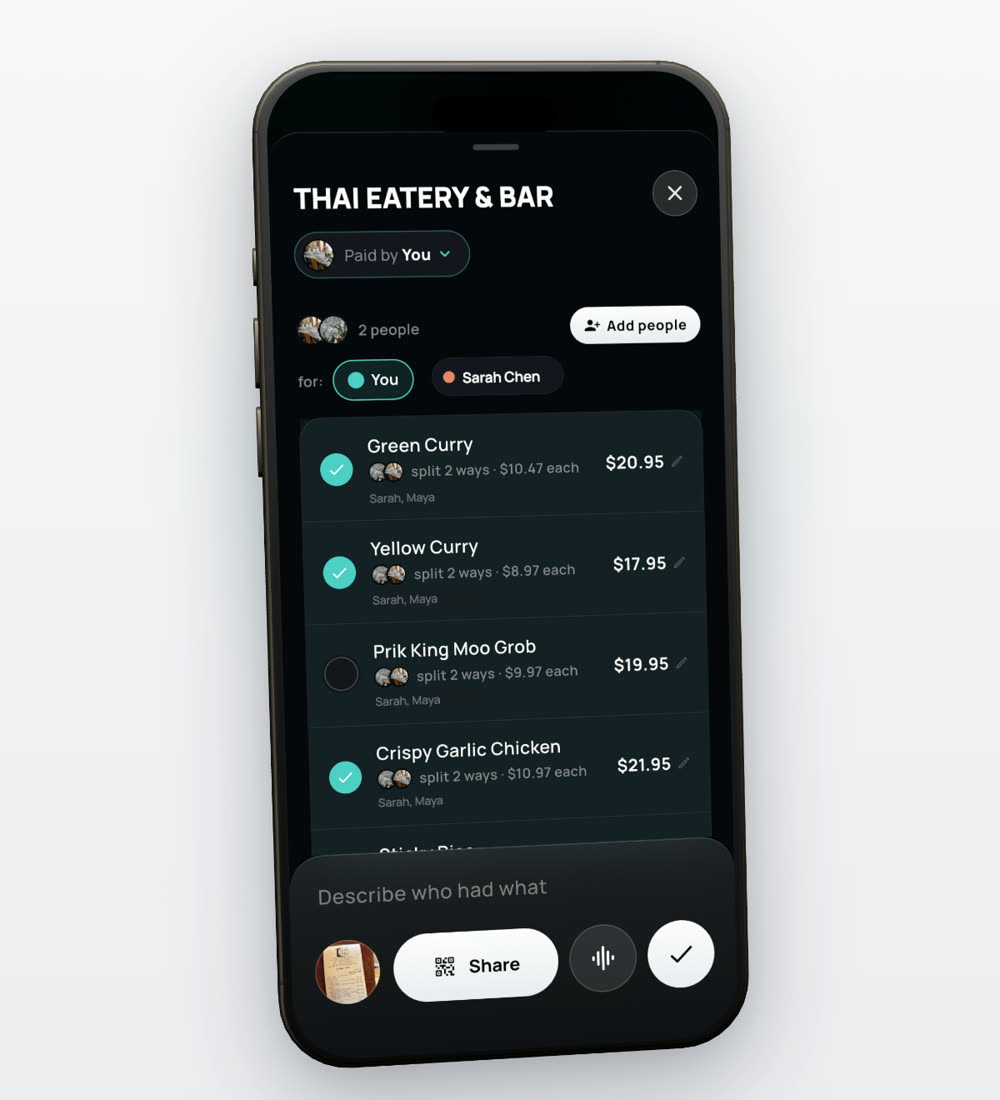
If you'd rather not do this by hand, use the calculator on this page, or scan the receipt and assign items to the people who had them in Chipp.
Does the person who paid get to keep the card points?
When one person puts the whole bill on their card and everyone pays them back, that person earns the rewards on the full amount. Is that fair?
Most people think yes, and for good reason:
- They fronted the money and took on the risk of someone not paying.
- They'll spend time collecting and following up.
- The rewards on a single dinner are usually small.
Where it starts to feel off is when the same person always pays because they want the points, on large bills, week after week. If that bothers anyone, two easy fixes:
- Rotate who pays so the points and the hassle both move around the group.
- Ask for separate checks at the start when the restaurant allows it, especially for big groups.
What isn't fair is the payer rounding everyone's share up and keeping the difference, or charging a fee for fronting the bill. Points are a side effect. Profit is not.
Paying the person back
The split only works if the money actually moves. A few habits help:
- Send the breakdown the same night. A message with each person's amount, or a shared expense everyone can see, is easier to act on than “you owe me for dinner.”
- Round to the nearest dollar if the table agrees. Let the extra cents go toward the tip.
- Pay within a day or two. Small debts are the easiest to forget.
In Chipp, the payer logs the dinner once, each person's share shows up for them, and they can settle in one tap through Venmo, Cash App, Zelle, PayPal, bank, or Chipp Balance. If you eat out with the same people often, keeping a running balance and settling monthly beats a dozen small transfers. For a quick number without the walkthrough, use the bill split calculator.
Questions people ask
How do you split tax and tip on an uneven bill?
Split them in proportion to what each person ordered. Divide the bill's total, including tax and tip, by the subtotal before tax and tip to get a multiplier, then multiply each person's item total by it. If the total is $153.60 on a $120 subtotal, the multiplier is 1.28, so someone with $40 of food owes $51.20.
Should you tip on the pre-tax or post-tax amount?
Many people tip on the pre-tax subtotal because tax isn't part of the service, while others tip on the total for simplicity. The difference is small, usually under a dollar or two on a typical dinner. Either is reasonable. What matters when splitting is that the whole table uses the same base, so everyone's tip is the same percentage of their food.
Is it rude to ask for an itemized split instead of an even split?
No, especially when orders were very different. It's reasonable to say you only had a salad and would rather pay for what you ordered plus tax and tip. Saying it early, before the check arrives, feels less awkward than objecting after someone has already divided the total. Many groups itemize by default and nobody thinks twice about it.
How do you split a shared appetizer?
Divide the appetizer's price among only the people who ate it, and add each share to their own item total before working out tax and tip. A $24 appetizer shared by three people adds $8 to each of their subtotals. If someone didn't have any, they don't pay for it. Shared bottles of wine work the same way.