
Rent split calculator
with the math shown.
Enter your total rent and each roommate's room, and the calculator splits it equally, by room size, by size plus shared space, or by income, with adjustments for extras like a private bathroom. Below the calculator you'll find how each method works, worked examples you can check by hand, when each method is fairest, and the mistakes that make a split feel unfair.


Rent split calculator
Example filled in: three roommates, $2,400 rent, rooms of 160, 120 and 100 sq ft, a private bathroom worth $90 and a parking space worth $60. Change anything and the shares update.
| Name | Room sq ft | Extras ($/mo value) | Income ($) |
|---|
What to enter
Before you start, gather:
- Total monthly rent, without utilities. Split those separately; see how to split utilities with roommates.
- Each bedroom's size in square feet. Measure the bedroom floor only, the same way for every room.
- Any extras a room comes with, such as a private bathroom, parking or a balcony, and a monthly value you agree on for each.
- Each person's monthly income, only if you plan to split by income.
How to measure a bedroom: measure the length and width of the floor in feet, wall to wall, and multiply. A room 12 ft by 11 ft is 132 sq ft. For an L-shaped room, split it into two rectangles and add them. Decide as a group whether closets count, then apply that rule to every room. Your lease or the listing may show the apartment's total size, but you need each bedroom on its own.
Every method below gives totals that add up to the full rent. If yours do not, something was entered twice.
Equal split
Rent divided by the number of people. Four roommates on $3,200 each pay $3,200 / 4 = $800.
Fairest when the bedrooms are within about 20 sq ft of each other and nobody has a private bathroom. It is also the easiest to keep running month to month.
By room size
Each person pays their bedroom's share of total bedroom space.
Formula: your rent = your room's sq ft / total bedroom sq ft × total rent.
Example: four roommates, $3,200 rent, rooms of 180, 150, 130 and 110 sq ft. Total bedroom space is 570 sq ft.
- 180 sq ft: 180 / 570 × $3,200 = $1,010.53
- 150 sq ft: 150 / 570 × $3,200 = $842.11
- 130 sq ft: 130 / 570 × $3,200 = $729.82
- 110 sq ft: 110 / 570 × $3,200 = $617.54
Check: these add up to $3,200.00. This method is the simplest to explain but tends to overcharge the big room, because it treats the kitchen and living room as if they belonged to whoever has the most bedroom space.
By size plus shared space
Split one part of the rent equally for shared space, and the rest by room size. Most people use 50% for shared space; if your living areas are unusually large or small, you can pick a different share.
Same apartment, with 50% for shared space:
- Shared half: $1,600 / 4 = $400 each
- Private half by room size: $505.26, $421.05, $364.91 and $308.77
- Totals: $905.26, $821.05, $764.91 and $708.77
Those totals add up to $3,199.99, one cent short, because of rounding. Give the leftover cent to one person, usually the largest room, so the biggest room pays $905.27. Small, but it means the payments add up to exactly what the landlord expects.
This is the method most roommates end up calling fair. The gap between the biggest and smallest room is $196.50 here, compared with $392.99 when splitting by room size alone.
Adjusting for extras
Give each extra a monthly value, such as "the private bathroom is worth $125 a month". The gap between that person and each roommate grows by exactly that amount, and the total rent stays the same.
Formula, for an extra worth X shared among n people: the person with the extra pays X × (n − 1) / n more, and everyone else pays X / n less.
Two-person example: $1,900 rent, rooms the same size, one has a private bathroom worth $125 a month.
- Bathroom room: $950 + $62.50 = $1,012.50
- Other room: $950 − $62.50 = $887.50
The gap between them is exactly $125, the value you agreed. To pick a value, ask each roommate what they would pay extra for the feature and use the middle answer.
By income
Each person pays the same percentage of their income.
Formula: your rent = your income / total income × total rent.
Example: two roommates, $2,100 rent, monthly incomes of $5,200 and $3,900. Total income is $9,100.
- $5,200 earner: 5,200 / 9,100 × $2,100 = $1,200
- $3,900 earner: 3,900 / 9,100 × $2,100 = $900
Both pay about 23% of their income. Use the same kind of income for everyone, either take-home pay or before-tax pay, never a mix. More on when this works in split rent by income.
Which method is fairest when
- Rooms within about 20 sq ft and no private bathrooms: equal.
- One clearly bigger room: size plus shared space.
- One room has a private bathroom or parking: size plus shared space, then extras.
- A couple, or friends with very different incomes who want to share costs by ability to pay: by income.
- Pure room size: rarely the best choice on its own, but useful as a starting point for discussion.
If you cannot agree, run two methods and look at the gap between the biggest and smallest room. In the four-person example above, pure room size gives a gap of $392.99 and size plus shared space gives $196.50. Many households settle somewhere in between by changing the shared-space share, for example 40% instead of 50%. Try a few values together and pick the one everyone can live with.
For the full conversation, including the master bedroom and what to put in writing, read how to split rent with roommates.
Common mistakes
- Counting a feature twice. Measuring the master including its bathroom and then also adding a bathroom premium.
- Measuring rooms differently. One room measured with the closet, another without.
- Rolling utilities into rent. Utilities change every month; rent does not. Keep them apart.
- Ignoring rounding. Make sure the shares add up to the rent to the cent.
- Mixing income types. One person's take-home pay against another's before-tax salary.
- Never revisiting it. Run the numbers again at lease renewal, when rent or roommates change.
- Forgetting the deposit. Most households split it in the same proportions as rent; see splitting a security deposit.
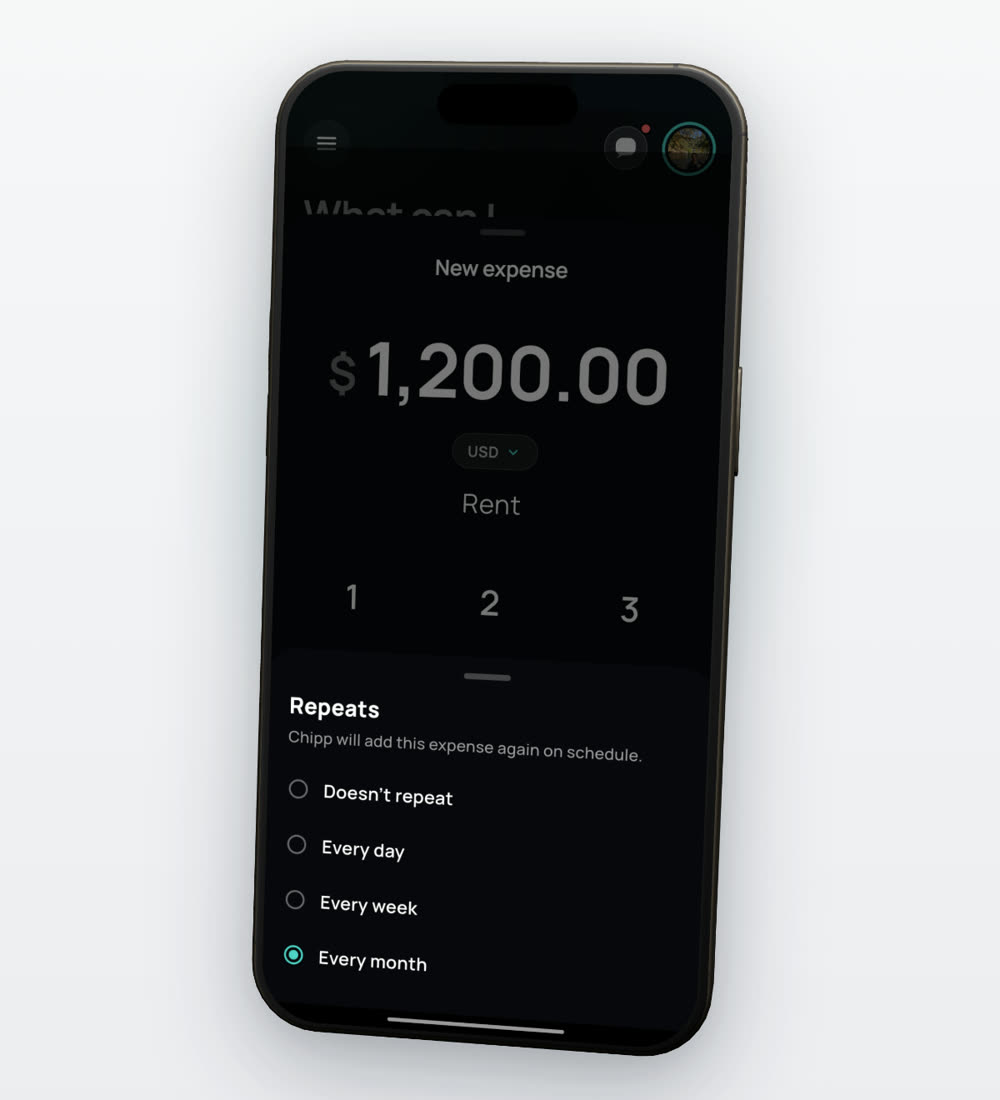
Once you have the numbers, you can set each person's share as a monthly recurring rent bill in Chipp (a Chipp+ feature), so nobody has to redo the math each month.
Questions people ask
How do you split rent by square footage?
Add up the square footage of all the bedrooms. Divide each bedroom's size by that total, then multiply by the rent. For rooms of 180, 150, 130 and 110 sq ft on $3,200 rent, the shares are $1,010.53, $842.11, $729.82 and $617.54. Many people split only half the rent this way and the other half equally.
How much more should you pay for a private bathroom?
There is no standard amount. Agree on a monthly value as a group, for example by asking what each person would pay extra and taking the middle answer. With two roommates and a $125 value, the person with the bathroom pays $62.50 more than an equal share and the other pays $62.50 less, so the gap is $125.
Should you include common areas when splitting rent by room size?
Yes, but split them equally rather than by bedroom size. Everyone uses the kitchen, living room and hallway about the same. A common approach is to split half the rent equally for shared space and the other half by bedroom square footage. Measure only bedroom floors for the size part, so shared space is not counted twice.
What income should I use to split rent by income?
Either take-home pay or before-tax pay works, as long as everyone uses the same one. Take-home pay reflects what people actually have to spend, so many couples prefer it. Use monthly figures, and agree on how to handle bonuses or irregular income, for example by averaging the last few months.