
How to ask a friend to pay you back
without making it weird.
Ask soon, ask once clearly, and make paying easy: name the amount, what it was for, and how to send it, in a friendly tone that assumes they simply forgot. Most people do pay once asked. This guide covers when to ask, how to word it, eight copy-paste texts for different situations, how long to wait before following up, and how to keep the friendship intact.


When to ask: sooner is kinder
The best time to ask is the same day or the next. That feels too fast to a lot of people, but it's actually the gentlest option. The details are fresh, the amount is obvious, and nobody has had time to wonder whether you were keeping score.
Waiting makes it harder for both of you. After a month, a $40 dinner turns into a whole conversation: did they forget, are they avoiding it, is it worth bringing up. After three months it can feel like an accusation even when it isn't.
A few situations where it helps to ask up front, before money moves at all:
- Group bookings. Ask for shares before you pay the deposit.
- Concert or event tickets. Ask when you buy them, not the week of.
- Anything over about $100. Agree on the amount and the payback date when you lend it.
If you already paid and didn't ask at the time, that's fine. Ask now. Late is still better than never, and much better than quietly resenting it.
Tone: assume they forgot
Almost everyone who owes a friend money intends to pay it. They forgot, they meant to do it later, or they weren't sure of the exact amount. Write as if that's true, because it usually is.
A good ask has four parts:
- The amount. A specific number, not “my share” or “the thing.”
- What it was for. “Saturday's tacos” or “your half of the Airbnb.”
- How to pay. Your Venmo, Zelle, Cash App or PayPal handle, so they can do it in ten seconds.
- A light close. “No rush” only if you mean it. Otherwise, “whenever you get a sec today.”
What to avoid:
- Apologizing. “Sorry to bother you” makes it sound like you're asking a favor. You're not.
- Hinting. “Man, rent is brutal this month” leaves them guessing. Be direct.
- Guilt. Mentioning how long it's been or how much you've covered before turns a reminder into a grievance.
- Public pressure. Calling someone out in a group chat or in front of others almost always backfires.
8 copy-paste texts for different situations
Change the names, amounts and handles. Keep them short.
1. Small amount, right after
“Hey, lunch was $18 each. My Venmo is @your-handle whenever you get a sec.”
2. Bigger amount
“Hey, for the concert trip (your ticket, half the hotel and your flight), it comes to $600. Could you send it by Friday? Zelle to this number works best for me. Thanks.”
3. It's been a few months
“Hey, this totally slipped my mind too, but I just noticed you still owe me $75 from the cabin weekend in June. Could you send it this week? Venmo @your-handle.”
4. Group chat, several people owe
“Settling up for Saturday: dinner was $240, so $60 each. Priya and Leo already sent theirs, thanks. Everyone else, my Venmo is @your-handle.”
5. Your partner's friend, or someone you don't know well
“Hi Chris, it was great meeting you Saturday. The boat rental came to $45 a person. Here's my Venmo if that's easiest: @your-handle. Thanks.”
6. After a trip
“Back home and did the math on the trip. You paid for dinner, I paid for the house, so after netting it out you owe me $290. Full breakdown is in our trip group. No rush, but could you send it by Sunday?”
7. You've already asked once
“Hey, just bumping this. Still need the $60 from Saturday's dinner. Let me know if the amount looks off.”
8. They're short on money right now
“I know things are tight right now, so no pressure to do it all at once. Would $200 a month for three months work? First one on the 1st?”
Worked example: turning $600 into a plan
Say you bought two concert tickets for $480 and paid $240 for the hotel room you shared, then booked your friend's $240 flight on your card. Their share is $240 for the ticket, $120 for half the room and $240 for the flight. Total: $600.
You send script 2. A week passes. They reply that they can't pay it all at once.
Rather than waiting and hoping, you offer a plan (script 8):
- October 1: $200, leaves $400
- November 1: $200, leaves $200
- December 1: $200, paid off
Why this works:
- It's specific. Three dates and three amounts are much easier to keep than “I'll pay you back soon.”
- It saves face. They get a way to pay that fits their budget, instead of avoiding you until they have $600.
- It's easy to track. You both know where things stand after each payment.
Put the plan in writing, even just a text, so nobody has to remember it. If a payment is late, a one-line reminder on the 2nd is normal, not rude.
How long to wait before following up
A simple timeline that works for most debts between friends:
- Day 0 to 1: first ask, with the amount and your handle.
- About a week later: one friendly bump (script 7). Assume it got buried.
- About two weeks later: a direct check-in. “Hey, is the $600 still doable? Happy to split it up if that's easier.”
- About a month in: talk in person or on the phone. Texts are easy to ignore; a short conversation usually isn't.
For small amounts, one ask and one follow-up is usually enough. If a friend doesn't pay back $12 after two reminders, decide whether it's worth a third. Sometimes letting a small one go, deliberately and without resentment, is the right call. Just don't lend that friend money again.
For a longer list of reminder wording, including firmer versions, see how to remind someone they owe you money. If it's a roommate and rent, the stakes are different, and what to do when a roommate won't pay rent covers that.
Keeping the friendship
Money is rarely what ends a friendship. Resentment is. A few habits keep it from building:
- Ask early and plainly, so it never becomes a big deal.
- Keep it private. One-on-one messages, not group call-outs.
- Separate the person from the payment. Your friend can be great and also bad at Venmo.
- Lend only what you could live without. If losing the money would end the friendship, think twice before lending it.
- Be easy to pay back. Share your handle every time. Every extra step is another chance to forget.
How a shared tracker removes the awkwardness
The hardest part of asking for money is that it feels personal: you're the one doing the asking. A shared tracker changes that. When expenses go into a group everyone can see, the balance is just a fact. Nobody has to remember the amount, defend it, or bring it up.
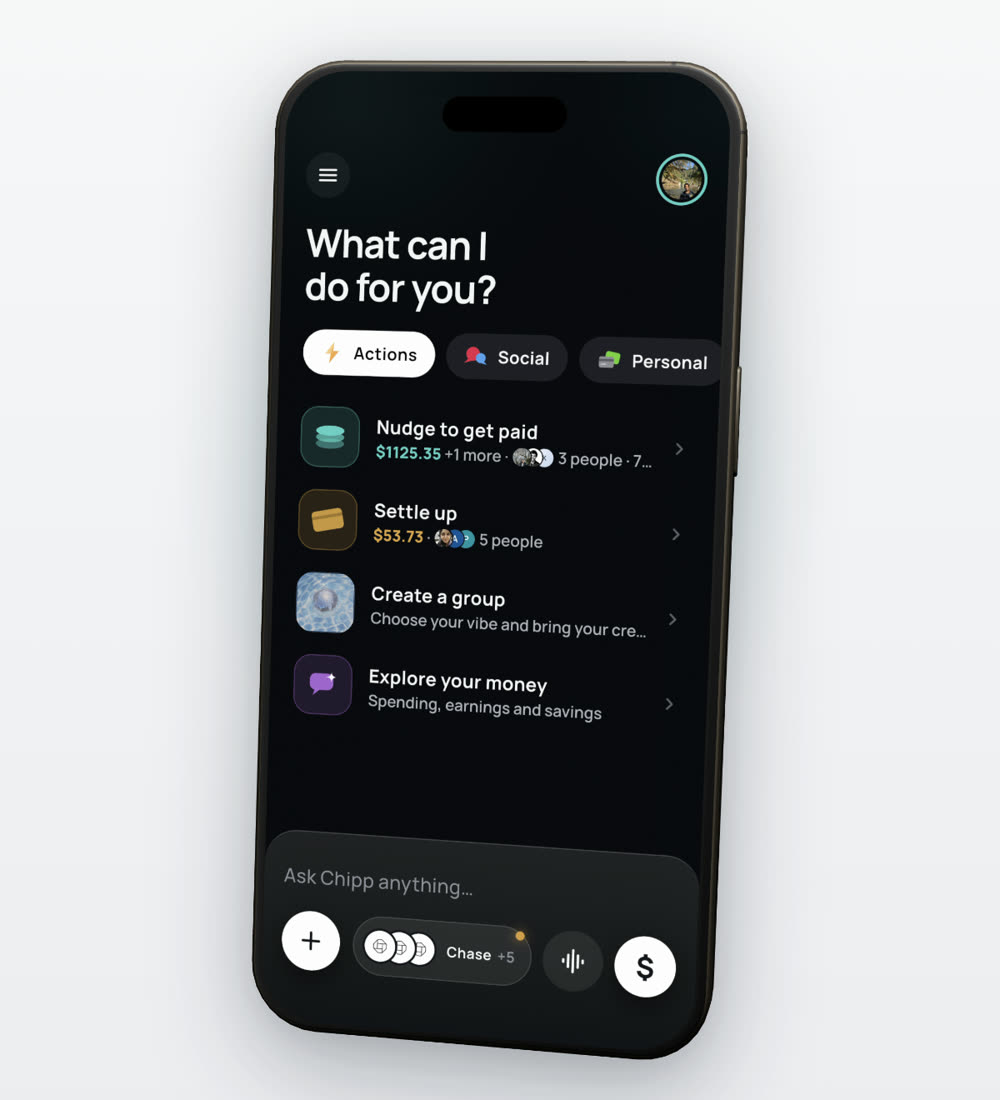
In Chipp, each expense goes into the group as it happens, everyone sees who owes what, and the app can send reminders and nudges so you don't have to write script 7 yourself. Your friend can settle in one tap through Venmo, Cash App, Zelle, PayPal, bank, or Chipp Balance. It's the same ask, without you having to be the one making it. For group trips especially, that makes a difference: see how to split trip costs with friends.
Questions people ask
How do you politely ask a friend to pay you back?
Send a short, specific message soon after: the amount, what it was for, and how to pay you, such as your Venmo or Zelle handle. Write as if they simply forgot, skip the apologies and hints, and keep it one-on-one. Something like “Hey, lunch was $18 each, my Venmo is @name whenever you get a sec” is polite and clear.
How long should you wait before asking someone to pay you back?
Ask the same day or the next, while the details are fresh. Waiting usually makes it more awkward, not less. If they don't respond, a friendly follow-up after about a week is normal, then a direct check-in at two weeks. For larger amounts, agree on a payback date when you lend the money so the timeline is clear from the start.
What do you do if a friend keeps ignoring your requests to pay you back?
After two or three texts, switch to a short phone call or in-person conversation, which is much harder to ignore. Ask whether the amount is still doable and offer a payment plan with specific dates. If it's a small sum, you may decide to let it go deliberately, and simply not lend to that friend again.
Is it rude to ask a friend for money they owe you?
No. Asking for money you're owed is normal, and most people would rather be reminded than find out later you were annoyed. What can come across as rude is the delivery: public call-outs, guilt, or sarcasm. A direct, friendly message with the amount and your payment handle is not rude.