
How to split rent by income
so it feels fair to both.
To split rent by income, divide each person's income by your combined income, then multiply that percentage by the rent. With $3,000 rent and incomes of $90,000 and $60,000, the split is 60/40: $1,800 and $1,200. Below are the formula, worked examples for two and three people, gross versus after-tax income, caps and hybrids, and how to bring it up without it getting awkward.


Rent split calculator
Example filled in: three roommates, $2,400 rent, rooms of 160, 120 and 100 sq ft, a private bathroom worth $90 and a parking space worth $60. Change anything and the shares update.
| Name | Room sq ft | Extras ($/mo value) | Income ($) |
|---|
The proportional rent formula
The formula is one line:
Your share = rent × (your income ÷ combined income)
Step by step:
- Add up everyone's income. Use the same kind of number for everyone: all yearly or all monthly, all before tax or all after.
- Divide each person's income by the total. That's their percentage.
- Multiply the rent by each percentage.
- Round to whole dollars and check that the shares add back up to the rent.
The reason people like this method is the property it guarantees: everyone ends up paying the same percentage of their income in rent. The higher earner pays more dollars, but nobody is stretched further than anyone else. You can run your own numbers in the calculator on this page.
Worked example: $3,000 rent, $90k and $60k
Alex earns $90,000 a year and Sam earns $60,000. Their rent is $3,000 a month.
- Combined income: $90,000 + $60,000 = $150,000.
- Alex's share: $90,000 ÷ $150,000 = 60%. Sam's share: $60,000 ÷ $150,000 = 40%.
- Alex pays $3,000 × 60% = $1,800. Sam pays $3,000 × 40% = $1,200.
Check the fairness property. Alex's gross monthly pay is $7,500, and $1,800 is 24% of it. Sam's is $5,000, and $1,200 is also 24%. Compare that with an even split of $1,500 each: 20% of Alex's pay but 30% of Sam's.
Three people works the same way. Rent is $3,600, and incomes are $100,000, $70,000 and $50,000, for a total of $220,000. The percentages are about 45.5%, 31.8% and 22.7%, which gives $1,636.36, $1,145.45 and $818.18. Rounded to $1,636, $1,146 and $818, it adds up to exactly $3,600. When rounding leaves you a dollar short or over, give the extra dollar to whoever had the largest fraction cut off.
Gross or after-tax income?
Gross income is simpler: it's the number on your offer letter, and nobody has to share a pay stub. After-tax, or take-home, income is usually fairer, because it's the money you actually live on. The two can differ more than people expect when one person has bigger retirement contributions, health premiums, or a higher tax bracket.
Same couple, after-tax: Alex takes home $5,600 a month and Sam takes home $4,000, for $9,600 combined.
- Alex: $5,600 ÷ $9,600 = 58.3%, so $1,750
- Sam: $4,000 ÷ $9,600 = 41.7%, so $1,250
The difference here is $50 a month. Pick whichever one you both find easier to agree on, and use it consistently.
A few edge cases to settle up front:
- Bonuses and side income: include them if they're regular, or use the last twelve months' total.
- Irregular income: freelancers and gig workers can use a twelve-month average, or a conservative baseline they're confident about.
- Retirement contributions: some couples add pre-tax contributions back in, so one person's saving doesn't lower their rent.
Variations: caps, floors and hybrids
A pure proportional split can feel lopsided when incomes are very far apart. These adjustments are common:
- Half and half. Split half the rent equally and half by income. With $3,000 rent: $1,500 split evenly is $750 each, and $1,500 split 60/40 is $900 and $600. Alex pays $1,650 and Sam pays $1,350. It's a middle ground between equal and proportional.
- A cap. The higher earner never pays more than an agreed share, such as 65% or 70%, however the incomes change.
- A floor. The lower earner always pays at least an agreed amount. Some people want to contribute a meaningful share even when they earn much less, and a floor makes that explicit.
- Space-adjusted. If the higher earner gets the bigger bedroom or a home office, combine income with room size, or charge for the extra room first and split the rest by income.
For roommates who aren't a couple, splitting by room size is more common than by income. The roommate rent guide covers those methods.
When income-based rent makes sense
It tends to work well for:
- Couples who share a home and a life, and think of the household as a team
- Friends with very different incomes who want to live together without the lower earner being priced out
- Households where one person is between jobs, studying or freelancing for a while
It works less well when the higher earner feels they are subsidizing a lifestyle they didn't choose, such as a pricier apartment the other person wanted. In that case, a split based on what each person would pay alone is often fairer.
Whatever you choose, agree on when you'll recalculate. Once a year, at lease renewal, or whenever someone changes jobs is a sensible rhythm. Updating the numbers on a schedule is far easier than reopening the whole conversation each time.
How to bring it up kindly
Lead with the goal, not the math. Raise it before you sign a lease, not after a tight month. And offer it as an option rather than a verdict.
If you're the higher earner:
- "I've been thinking about rent. Since I earn more, would it feel fairer if we split it by income? It would be about 60/40, so we'd both be putting the same share of our pay toward it."
If you're the lower earner:
- "Can we talk about how we split rent? Half is taking a lot of my paycheck, and I'd love to find something that feels fair to both of us. One option is splitting by income. Could we look at the numbers together?"
Then actually look at the numbers together, with the calculator open. Agree on gross or take-home pay, on any cap or floor, and on when you'll revisit it. If you're working out the rest of your shared costs too, splitting expenses with a partner covers groceries, bills and what to keep separate.
Set it up once and stop recalculating
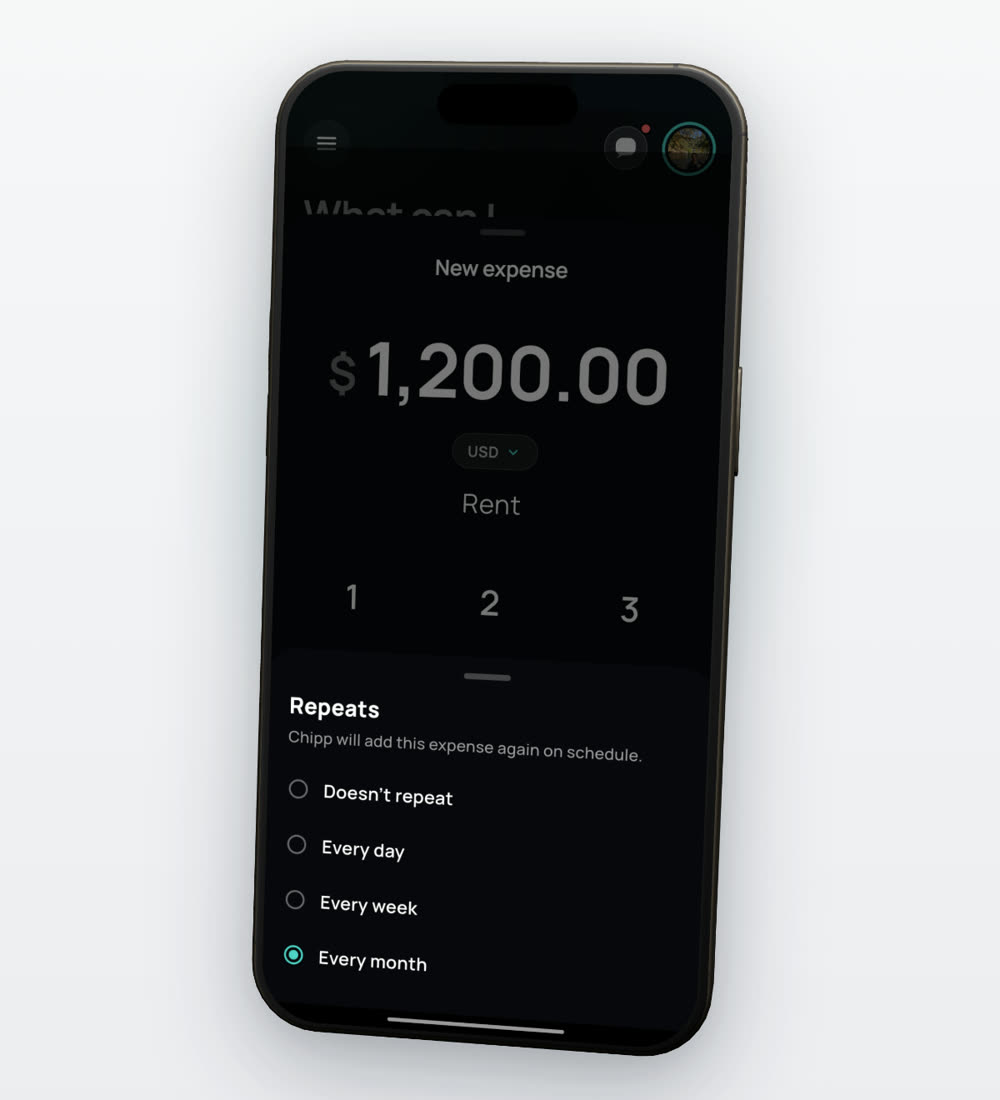
Once you've agreed on percentages, write them down and stop doing the math every month. In Chipp, you can add rent as an expense that repeats every month (Chipp+) with your custom split, so each person's share is posted automatically, and settle up through Venmo, Cash App, Zelle, PayPal or your bank.
If one of you pays the landlord the full amount, the other person's share simply shows as owed each month until it's settled, so nobody has to send an awkward reminder. A spreadsheet with the percentages in one cell works too, as long as you both look at the same one.
Put a reminder in your calendar for the date you agreed to recalculate, and update the split then.
Questions people ask
Is splitting rent by income fair?
Many people find it fairer than 50/50 when incomes differ, because each person pays the same percentage of their income. The higher earner pays more dollars but keeps more left over. It isn't the only fair method, though. Some couples prefer equal splits for simplicity, or a hybrid that splits part of the rent equally and part by income.
Should you use gross or net income to split rent?
Either works if you use the same kind of number for everyone. Net, or take-home, income is often fairer because it reflects money you can actually spend, especially when one person has larger retirement contributions or health premiums. Gross income is simpler and avoids sharing pay stubs. The difference is often modest, so choose the one you both agree on.
How do you split rent by income with three roommates?
Add all three incomes, divide each person's income by the total to get their percentage, and multiply the rent by each percentage. For $3,600 rent with incomes of $100,000, $70,000 and $50,000, the shares are about $1,636, $1,146 and $818. Round to whole dollars and confirm the shares add up to the full rent.
What if one partner has no income?
A pure income split would put all the rent on one person, which may be exactly right for a household that works as a team, for example while one partner studies or cares for children. Some couples prefer a small fixed contribution from the partner without income, or a floor, so both feel involved. It's a values question more than a math one.