
How to split rent with roommates
fairly, and in writing.
The fairest way to split rent with roommates is usually to split shared space equally and private space by bedroom size, then adjust for extras like a private bathroom or parking. If the rooms are similar, an equal split is fine. This guide works through all four methods on the same three-person apartment, covers the master bedroom, and gives you a script and the clauses to put in writing.


Rent split calculator
Example filled in: three roommates, $2,400 rent, rooms of 160, 120 and 100 sq ft, a private bathroom worth $90 and a parking space worth $60. Change anything and the shares update.
| Name | Room sq ft | Extras ($/mo value) | Income ($) |
|---|
The four fair ways to split rent
- Equal. Rent divided by the number of people. Best when the rooms are close in size and nobody has a private bathroom.
- By room size. Each person pays in proportion to their bedroom's square footage. Simple, but it ignores the fact that everyone uses the kitchen and living room equally.
- Size plus shared space, then features. Split part of the rent equally for shared space, the rest by bedroom size, then adjust for a private bathroom, parking, a balcony or a closet. This is the method most households end up calling fair.
- By income. Each person pays the same share of their income. Common for couples, less common for roommates, but sometimes right for friends with very different pay.
Utilities are usually split equally and kept separate from rent. See how to split utilities with roommates.
A worked example: three roommates, $2,400 rent
Ana, Ben and Cole rent a three-bedroom for $2,400 a month. Ana's room is 160 sq ft, Ben's is 120 and Cole's is 100. Ana's room has a private bathroom. Cole uses the one parking space.
Method 1, equal: $2,400 / 3 = $800 each.
Method 2, by room size: total bedroom space is 160 + 120 + 100 = 380 sq ft.
- Ana: 160 / 380 × $2,400 = $1,010.53
- Ben: 120 / 380 × $2,400 = $757.89
- Cole: 100 / 380 × $2,400 = $631.58
That puts Ana at $379 more than Cole, even though they share the same kitchen.
Method 3, size plus shared space: the roommates agree half the rent pays for shared space. $1,200 / 3 = $400 each. The other $1,200 is split by room size: Ana $505.26, Ben $378.95, Cole $315.79.
- Ana: $400 + $505.26 = $905.26
- Ben: $400 + $378.95 = $778.95
- Cole: $400 + $315.79 = $715.79
Then features. They agree Ana's private bathroom is worth $90 a month more to her than to the others, and the parking space is worth $60 a month to Cole. With three people, the person with a feature pays two-thirds of its value extra, and the other two each pay one-third less, so the total stays at $2,400.
- Bathroom: Ana +$60, Ben −$30, Cole −$30
- Parking: Cole +$40, Ana −$20, Ben −$20
- Ana: $905.26 + $60 − $20 = $945.26
- Ben: $778.95 − $30 − $20 = $728.95
- Cole: $715.79 − $30 + $40 = $725.79
Check: $945.26 + $728.95 + $725.79 = $2,400.00. Ana now pays $216.31 more than Ben, which reflects her bigger room and her own bathroom. You can run your own numbers in the rent split calculator.
How to handle the master bedroom
The master bedroom is where most rent arguments start. A few ways to settle it:
- Use size plus shared space. It charges for the extra square feet without making the master holder pay for the whole kitchen twice.
- Price the extras separately. A private bathroom, a walk-in closet or a balcony each get a dollar value. Agree on the value before anyone picks a room.
- Bid for it. Each person writes down privately what they would pay for each room, with the totals adding up to the rent. The room goes to whoever values it most, and the rent is set from the bids. It feels formal, but it ends the "you got the good room" conversation.
- Rotate. On a multi-year lease, swap rooms at each renewal and use the equal split.
What does not work well: the master holder paying a vague "a bit more". Put a number on it.
Pricing features like a private bath or parking
There is no official price for a private bathroom. A fair way to set one: ask what each roommate would pay extra per month to have it, and use the middle answer. Same for parking, a balcony, a window that gets light, or the room next to the noisy street, which might be worth a discount.
Keep features separate from square footage. If you measure Ana's room including her bathroom and then also add a bathroom premium, she pays for it twice. Measure only the bedroom floor.
When splitting by income makes sense
Splitting by income means each person pays the same percentage of what they earn. If Ana earns $6,000 a month, Ben $4,500 and Cole $3,500, total income is $14,000.
- Ana: 6,000 / 14,000 × $2,400 = $1,028.57
- Ben: 4,500 / 14,000 × $2,400 = $771.43
- Cole: 3,500 / 14,000 × $2,400 = $600.00
Everyone pays about 17% of their income. This works for couples and close friends who see the home as shared. Between roommates it can feel unfair to the higher earner, and it means sharing pay details, so only use it if everyone suggests it freely. The split rent by income guide goes deeper.
How to agree on it without the awkward talk
Do this before anyone moves in, and before anyone picks a room. A message you can send:
"Before we pick rooms, can we agree how to split rent? I'd suggest half split equally for the shared space, half by bedroom size, plus something extra for the private bathroom and the parking spot. I put the numbers in a calculator: [paste]. Happy to change the bathroom and parking amounts if they feel off."
Then:
- Measure every bedroom the same way, wall to wall, closets in or out for everyone.
- Agree on feature values as a group.
- Run the numbers and share them.
- Pick rooms only after the prices are set.
What to put in writing
A short roommate agreement saves you later. Copy and adapt these clauses:
- "Monthly rent is $2,400. Ana pays $945.26, Ben $728.95, Cole $725.79."
- "Rent is due to [name] by the 25th, who pays the landlord by the 1st."
- "Utilities and internet are split equally and settled monthly."
- "If someone pays late, they cover any late fee the landlord charges."
- "If someone moves out early, they keep paying their share until a replacement the others approve moves in, or the lease ends."
- "The security deposit is split in the same proportions as rent."
- "We'll review the split at each lease renewal."
For a full template, see the roommate agreement template.
Keep it running every month
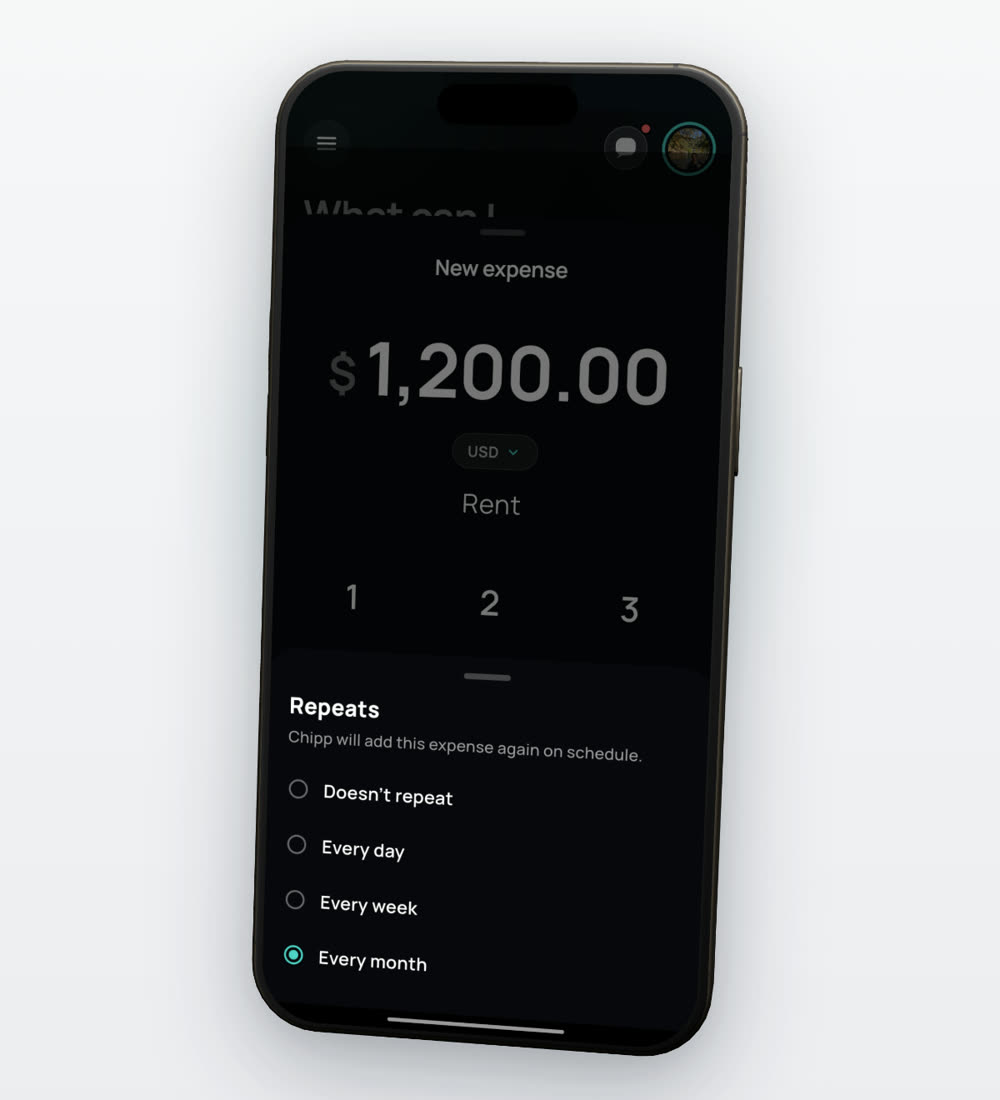
Once the split is agreed, the hard part is the monthly routine. In Chipp you can set rent as a recurring bill that repeats every month with each person's exact share (recurring bills are part of Chipp+). Chipp can send reminders, and each roommate settles in one tap through Venmo, Cash App, Zelle, PayPal or their bank. The utilities and grocery runs go in the same group, so there is one balance per person instead of three separate threads.
Questions people ask
What is the fairest way to split rent with roommates?
For most apartments, split part of the rent equally for shared space such as the kitchen and living room, split the rest by bedroom size, then add a set amount for extras like a private bathroom or parking. If the rooms are about the same size and nobody has extras, an equal split is simplest and usually fair enough.
How much more should the master bedroom pay?
There is no fixed rule. Work it out from size and features: split shared space equally, split the bedroom portion by square footage, then add an agreed value for a private bathroom or walk-in closet. In the example above, the master pays about $216 a month more than the middle room on $2,400 rent.
Should utilities be split by room size too?
Usually not. Electricity, water and internet are used roughly equally, so most roommates split them evenly and keep them separate from rent. The exception is something one person clearly uses more, such as a space heater or a home office running all day. Agree on that up front rather than adjusting bills after the fact.
Is it fair to split rent by income?
It can be, especially for couples or close friends who want everyone to pay the same share of their income. Between ordinary roommates it is less common, because the higher earner pays more for the same space and everyone has to share their pay. Use it only if everyone agrees freely, and write it down.