
How to split expenses with your partner
without keeping score.
Most couples use one of four systems: split everything 50/50, split in proportion to income, pool everything into joint money, or a hybrid where shared bills come from a joint pot and the rest stays separate. The right one is the one you both genuinely think is fair. This guide compares them with real numbers, then covers what to share, what to keep separate, and how to check in without it feeling like an audit.


The four ways couples split money
- 50/50. Every shared cost is split down the middle. It's simple and feels equal, and it works well when you earn similar amounts. When incomes differ a lot, the lower earner can end up spending most of their pay on shared life while the higher earner has plenty left over.
- Proportional to income. Each person pays the same percentage of their income toward shared costs. If one of you earns 60% of the household income, they cover 60% of the shared bills. It feels fairer when incomes are far apart, and it needs a short conversation about numbers.
- All in, joint. All income goes into shared accounts and all spending comes out of them. Common for married couples and for households where one partner earns little or nothing, for example while caring for kids. It takes the most trust and the most agreement on spending habits.
- Hybrid: yours, mine and ours. Each of you contributes to a joint account or shared pot, either 50/50 or proportionally, and it pays the shared bills. Everything else stays personal. Many couples land here because it shares the household while leaving each person some money they don't have to justify.
None of these is the right answer for everyone. Couples also move between them over time, often from 50/50 when they first move in to a hybrid or joint system later.
A worked example with two incomes
Jess takes home $8,000 a month and Marcus takes home $5,000. Their shared costs are:
- Rent: $2,400
- Utilities and internet: $300
- Groceries: $800
- Shared subscriptions: $100
- Dinners out together: $300
That's $3,900 a month.
50/50: each pays $1,950. Jess has $6,050 left for everything else. Marcus has $3,050. Marcus is spending 39% of his take-home on the shared life, and Jess is spending 24%.
Proportional: together they take home $13,000. Jess earns 61.5% of that and Marcus earns 38.5%. Jess pays $2,400 and Marcus pays $1,500. Now both are putting exactly 30% of their take-home toward shared costs, and Jess still has more left over: $5,600 against Marcus's $3,500.
Hybrid: they open a joint account. Jess transfers $2,400 and Marcus $1,500 each month, and all five shared bills come out of it. Each keeps the rest in their own account.
All joint: both paychecks go into shared accounts, the $3,900 comes out first, and they agree how much of the remaining $9,100 each can spend freely before checking with the other.
If they choose a proportional or hybrid split, the split rent by income guide shows the formula step by step, including whether to use gross or after-tax pay.
What to split and what to keep separate
Most couples share:
- Rent or mortgage, utilities, internet and home insurance
- Groceries and household supplies
- Subscriptions you both use
- Trips and dinners you take together
- Shared pets, furniture and anything else bought for the home
Most couples keep separate:
- Personal spending: clothes, hobbies, a gym, nights out with your own friends
- Gifts for each other, which feel odd paid from a shared pot
- Debts from before the relationship, like student loans or a car loan. Some couples choose to help each other with these, but it works better as a decision than a default.
- Individual retirement and savings accounts, even if you set goals together
The grey areas are where the friction lives. A car that one person drives most days, a phone plan you share, a family trip to see one partner's parents. Talk about these on purpose rather than splitting them by habit.
How to choose a system together
Have the conversation when nothing is wrong, ideally before you move in or sign a lease. A few questions get you most of the way:
- Roughly what does each of us take home each month?
- What do we each consider a shared cost?
- Do we want the same amount left over, or the same share of our income going to shared life?
- How much can each of us spend without checking with the other?
- When will we look at this again?
If one partner earns little or nothing for a while, because of study, a job search or caring for family, a strict percentage split stops making sense. Most couples in that spot either go fully joint or have the earning partner cover the shared bills, with a small personal allowance for each person so nobody has to ask permission for a haircut.
If you can't agree, start with a proportional split for the big fixed bills and 50/50 for everything else, then revisit in three months. Big changes like a new job, a pay cut, marriage, or a baby are natural moments to reset. If you're about to move in, the moving in together checklist covers the rest of the setup.
Tracking it without keeping score
The goal of tracking is to stop thinking about money, not to think about it more. Some habits that help:
- Settle monthly, not per coffee. Log shared costs as they happen, then square up once a month. Nobody wants a $4.50 request after breakfast.
- Set the split once. Agree on your percentages and use them for every shared bill, instead of negotiating each one.
- Let the small stuff go. Many couples agree that anything under $20 or so just doesn't get tracked.
- Automate the fixed bills. Rent and utilities are the same every month, so set them up once.
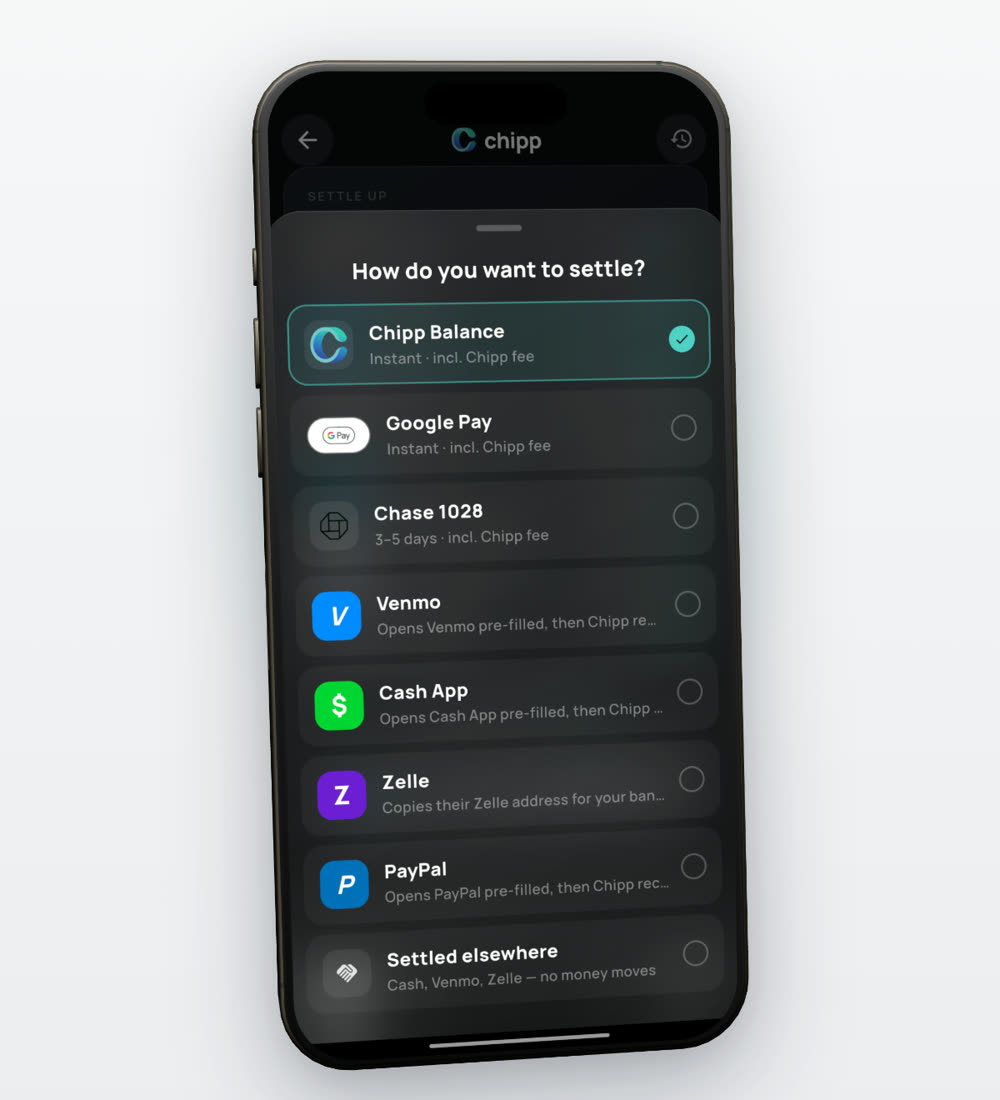
In Chipp, you can keep a shared group with your agreed split, have rent and utilities repeat each month (Chipp+), and ask the assistant "how much do I owe Marcus this month?" instead of opening a spreadsheet. When it's time to settle, it's one tap through Venmo, Cash App, Zelle, PayPal or your bank. If you'd rather use a spreadsheet, the shared expenses guide covers that too.
Check-ins that don't feel like audits
A short monthly money check-in keeps small resentments from building. Keep it to twenty minutes and use the same agenda each time:
- Settle up for the month.
- Look at anything unusual: a big repair, a trip, a month where groceries jumped.
- Ask whether the split still feels fair to both of you.
- Look ahead at next month's big costs.
- Talk about one shared goal, like a trip or an emergency fund.
Use "we" language: "our grocery bill went up" lands differently than "you spent a lot on groceries". And if one of you feels the system has stopped being fair, that's the signal to change it, not to defend it.
Questions people ask
Should couples split bills 50/50?
50/50 works well when you earn similar amounts and like the simplicity. When incomes are far apart, it can leave the lower earner spending a much bigger share of their pay on shared life. In that case, many couples switch to a proportional split, where each person pays the same percentage of their income toward shared costs.
How do you split expenses when one partner earns more?
Add your incomes together, work out each person's percentage of the total, and use those percentages for shared bills. If one partner takes home $8,000 and the other $5,000 a month, they split shared costs about 61.5/38.5. Both then contribute the same share of their income, and the higher earner still keeps more in absolute terms.
Should couples have a joint bank account?
It's optional. A joint account for shared bills makes paying rent and utilities simpler and removes the need to pay each other back. Many couples keep personal accounts alongside it, so each person has money they don't have to discuss. Some couples skip joint accounts entirely and track shared costs in an app instead.
How do unmarried couples split rent?
The same ways married couples do: 50/50, proportional to income, or a hybrid. The main difference is that unmarried partners have fewer default legal protections if they break up, so it's sensible to keep a clear record of who paid what, especially for deposits and furniture bought together, and to know whose names are on the lease.