
How to split utilities with roommates
without metering every outlet.
Most households split utilities equally, then add a small, agreed adjustment for anyone whose usage is clearly higher, like a full-time remote worker or a space heater running all winter. This guide covers equal versus usage-based splits, seasonal swings, whose name goes on each account, a worked example for four roommates, and how to set it up once so it repeats every month.


Utility split calculator
Example filled in: four roommates, one away for part of the month. Bills set to "by days home" are shared by the nights each person was there.
| Bill | Amount ($) | Split |
|---|
| Roommate | Days home |
|---|
Which utilities do roommates usually split?
Start by listing every bill that serves the whole home. In a typical rental that means:
- Electricity: lights, fridge, laundry, and often heating or air conditioning.
- Gas: heat, hot water, the stove. Many apartments don't have gas at all.
- Water, sewer and trash: sometimes included in rent, sometimes billed quarterly. Check your lease.
- Internet: a flat monthly price, which makes it the easiest bill to split.
- Streaming and shared subscriptions: optional. Only the people who actually use a service should pay for it.
Leave personal things off the list. Phone plans, a gym, or someone's own cloud storage are not house bills, even if one person happens to pay them for a friend.
Write down each bill's typical amount, its due date, and whose name it's under. That one list answers most of the questions that cause friction later.
Equal split or usage-based: which is fairer?
An equal split is the right default. It's simple, nobody has to justify their shower length, and in most homes the differences in usage are small enough to wash out over a year.
A usage-based adjustment is worth it when one person's usage is obviously and consistently higher. Common cases:
- Someone works from home full time, running a laptop, monitors and heating or cooling all day while everyone else is out.
- Someone uses a space heater or a window air conditioner in their own room.
- A partner stays over most nights and is effectively a fourth roommate.
- One room has its own AC unit, or someone runs a power-hungry gaming PC for hours a day.
You don't need meters or spreadsheets of kilowatt-hours. Use a base plus adjustment method: agree on a flat monthly amount for the extra usage, take it off the top of that bill, and split the rest equally. A reasonable estimate everyone accepts beats a precise number nobody trusts.
To estimate a device, multiply its wattage by the hours it runs. A 1,500-watt space heater running four hours a night uses about 6 kWh a day, or roughly 180 kWh a month. At 17 cents per kWh that's about $30. Use the rate printed on your own bill, since prices vary a lot by area.
A worked example: four roommates, $440 a month
Priya, Sam, Alex and Jordan share a house. A typical winter month looks like this:
- Electricity: $180
- Gas: $90
- Water and trash: $60
- Internet: $70
- Streaming: $40 ($16 for a service all four use, $24 for one Jordan doesn't watch)
An equal split of the whole $440 would be $110 each. Two things make that feel off: Priya works from home every weekday, and Sam runs a space heater most nights. They agree on a $20 adjustment for Priya and $30 for Sam, both taken off the electricity bill.
- Electricity: $180 minus $50 in adjustments leaves $130, or $32.50 each. Priya pays $52.50, Sam pays $62.50, Alex and Jordan pay $32.50.
- Gas: $90 split four ways is $22.50 each.
- Water and trash: $15 each.
- Internet: $17.50 each.
- Streaming: $4 each for the shared service, and $8 each for Priya, Sam and Alex for the second one.
Monthly totals:
- Priya: $119.50
- Sam: $129.50
- Alex: $99.50
- Jordan: $91.50
That adds back up to $440. Nobody is paying for a heater they don't use, and the adjustments are fixed numbers, so there's nothing to argue about each month. In summer, when the heater is off, Sam's adjustment drops to zero. You can try your own numbers in the calculator on this page.
How to handle seasonal swings
Utility bills move with the weather. A gas bill that's $40 in May can be $150 in January, and an apartment with central air can see the same jump in August. Pick one of these approaches and agree on it before the first big bill arrives:
- Split the actual bill every month. Fairest when everyone lives there all year. The downside is that a $200 month can surprise someone on a tight budget.
- Average it out. Many utilities offer a budget billing or level-pay plan that spreads the yearly total into equal monthly payments. Ask yours. You can also do it yourselves: each person pays a fixed amount, and you settle the difference every few months.
- Seasonal adjustment only. Keep the equal split, and turn on the heater or AC adjustment only for the months it applies.
Watch move-in and move-out dates. If someone leaves in March, they should still pay their share of the expensive winter bills they helped run up. Splitting by days lived in the home during each billing period is the cleanest rule.
Whose name goes on the account?
Every utility account has one holder, and that person is the one the company bills, charges late fees to, and may run a credit check on or ask for a deposit. Being the account holder is a real responsibility, so share it out:
- Spread the accounts. One person holds electricity, another holds internet, a third holds gas. Nobody carries all the risk.
- Don't let the holder float the money. Agree that everyone pays the holder within a few days of the bill posting, ideally before the due date.
- Record any deposit. If the holder paid a utility deposit, note who paid it and how much, so the refund goes to the right person later. The same logic applies to your security deposit.
- Plan the handover. When the holder moves out, the account needs to be transferred or closed and reopened. Decide who takes it over before the last month, not after.
Some providers let you add a second authorized person to an account. It's worth asking, especially for the internet, which tends to have the longest contracts.
Set it up once as a monthly recurring bill
The work in splitting utilities isn't the math. It's remembering to post every bill, every month, and chasing the money afterward. Set it up once:
- Make a household group with everyone in it.
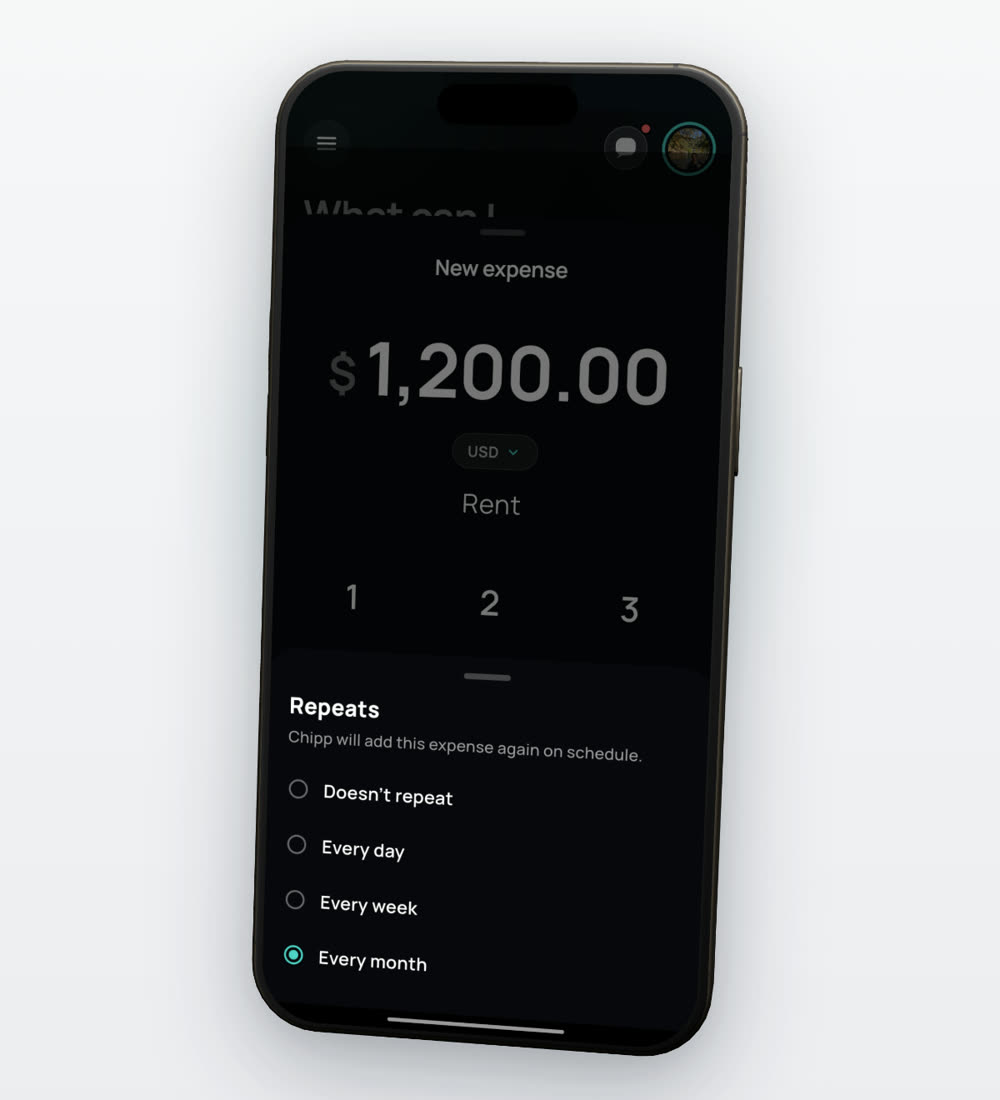
- Add each utility as an expense that repeats every month, with the split you agreed on, including any fixed adjustments.
- When a bill that varies arrives, update that month's amount. Fixed bills like internet need no attention.
- Let reminders do the chasing, so the account holder doesn't have to.
- Settle up once a month instead of after every bill.
In Chipp, recurring bills (part of Chipp+) repeat on their own each month, the group shows a running balance for each person, and anyone can settle up in one tap through Venmo, Cash App, Zelle, PayPal or their bank. A shared spreadsheet works too, as long as one person owns updating it.
Internet tends to have its own wrinkles, like who owns the router and who's on the contract, so it has its own guide.
Ground rules worth writing down
A few sentences agreed in advance prevent most utility arguments:
- How fast everyone pays the account holder after a bill posts. Three days is common.
- A thermostat range everyone can live with, so the heating bill isn't a weekly debate.
- When a frequent guest starts paying a share. A simple rule is more than a set number of nights a month.
- How the bills are split when someone moves in or out mid-month.
Put them in your roommate agreement next to rent and groceries, so everything about shared money lives in one place. If you're still working out the rent itself, start with how to split rent with roommates.
Questions people ask
Should utilities be split equally between roommates?
Usually, yes. An equal split is simple and fair when everyone lives there full time and uses the home in similar ways. Switch to an adjusted split only when one person's usage is clearly and consistently higher, such as working from home every day or running a space heater, and agree on a fixed monthly adjustment rather than measuring usage.
How do you split utilities when one roommate works from home?
Agree on a flat monthly amount that covers the extra electricity, heating or cooling, often $15 to $30 depending on your rates and climate. Take that amount off the top of the bill, charge it to the remote worker, and split the rest equally. Revisit it if their schedule changes or the season shifts.
How do you split utilities when someone moves in mid-month?
Split each bill by the days each person lived there during the billing period. If a $150 electric bill covers 30 days and a new roommate moved in on day 11, they lived there 20 of those 30 days. Work out a daily cost per person present and charge each roommate for the days they were there.
What if all the utilities are in one roommate's name?
That roommate carries the risk of late fees, deposits and any credit impact, so others should pay them promptly, within a few days of each bill. If you can, spread accounts across roommates when you set them up or at renewal, and write down who paid any utility deposits so refunds go back to the right people.